
Quick answer
Choose the club for the first activity. A short iron suits little chips and close targets. A child-sized driver can work for supervised swings from a tee when there's plenty of room. A putter is great for rolling games. If a coach is leading the session, follow their plan.
Adult golf advice does not always fit kids
Many adults learned golf with an iron first, so they assume kids should do the same. That can be right in some settings, especially for a lesson, a small target, or short swings. But it’s not the only safe first step.
A young beginner is usually not asking for a complete swing system. They’re asking, in their own way, for a first golf moment that feels clear, safe, and worth repeating. The better question is not driver or iron in the abstract. The better question is: what is the child trying to do first?
Choose equipment for your child and the game you’re about to play. Keep the first few turns short, supervised, and easy to understand.
Driver vs iron for kids: the simple parent rule
Start with the activity, then choose the club.
| First activity | Better first club | Why it fits |
|---|---|---|
| Rolling games | Putter | The child learns aim, pace, and turn-taking without a full swing. |
| Small targets | Short iron or wedge | The shorter club can fit chips, bumps, and controlled range work. |
| Supervised full swings | Child-sized driver on a tee | A tee-up setup can make the ball position clearer and keep the goal simple. |
| Lesson one | Ask the coach | Many beginner programs provide clubs or choose the club based on the drill. |
| Tight indoor space | No-ball swing, putter, or foam-ball setup | The room should decide the activity before the club does. |
When a driver can make sense first
A driver can make sense as a first full-swing club when the child is in a supervised open space, the club is child-sized, the ball is teed up, and the goal is one simple motion toward a safe target. This is especially relevant for kids who are excited by the idea of sending a ball forward, not just rolling or chipping it.
The caution is fit. PGA guidance on junior club fit warns that a driver that’s too long can create timing problems and make center-face contact harder. The same article points parents toward length, shaft flexibility, weight, and grip size as real junior fitting details.
That’s the useful distinction. Driver-first is not the same as adult-driver-first. A child-sized driver in a safe tee-up setup is a different choice from handing a child a long adult club and hoping they grow into it.
When an iron or wedge should come first
An iron or wedge can be the better first club when the session is about small targets, short swings, range lessons, or a coach-led drill. It can also be the better choice when the child is not ready to manage a longer club yet.
PGA's junior fit guidance says many early junior players can start with fewer clubs and then add longer clubs as they progress. That doesn’t mean every child must avoid a driver. It means parents should avoid buying the longest-looking option before the child can control it.
If the child is frustrated, missing the ball, or losing balance, don’t assume they need more swing tips. The club type, length, weight, tee height, ball type, and target may need to change first.
How the answer changes by age
Age is only a first filter, but it helps parents avoid adult expectations.
| Age band | What usually matters most | Practical first-club path |
|---|---|---|
| Ages 2-5 | Safety, attention span, play, and a simple first goal. | Start with rolling games, soft balls, no-ball swings, or a tee-up child-sized club in a clear space. |
| Ages 6-8 | More coordination, but still a need for short sessions and flexible rules. | Use putter, wedge, iron, or driver based on the drill and the child's control. |
| Ages 9-12 | Fit, interest, coaching context, and whether the child wants more shot variety. | Add longer clubs and more club choices as the child can explain and repeat the goal. |
HealthyChildren.org notes that children develop at different rates and that younger kids often need play, limited instruction, and age-appropriate equipment. For golf, that means a 4-year-old's first driver moment and a 10-year-old's first driver lesson should not be treated the same way.
Check the fit before choosing
Before deciding driver or iron, check four things:
- Height: the club lets the child stand naturally.
- Handedness: the club matches the child's right- or left-handed golf setup.
- Weight: the child can lift and stop the club without losing balance.
- Grip: both hands can sit together without the handle feeling too large.
U.S. Kids Golf uses player height, swing side, and development level in its fitting center. That’s the right parent mindset before any driver-vs-iron decision: fit the child first, then choose the club type.
For a broader fit checklist, read what makes a kids golf club easier to swing. For the age and height guide, use kids golf club size by age.
For those first swings from a tee
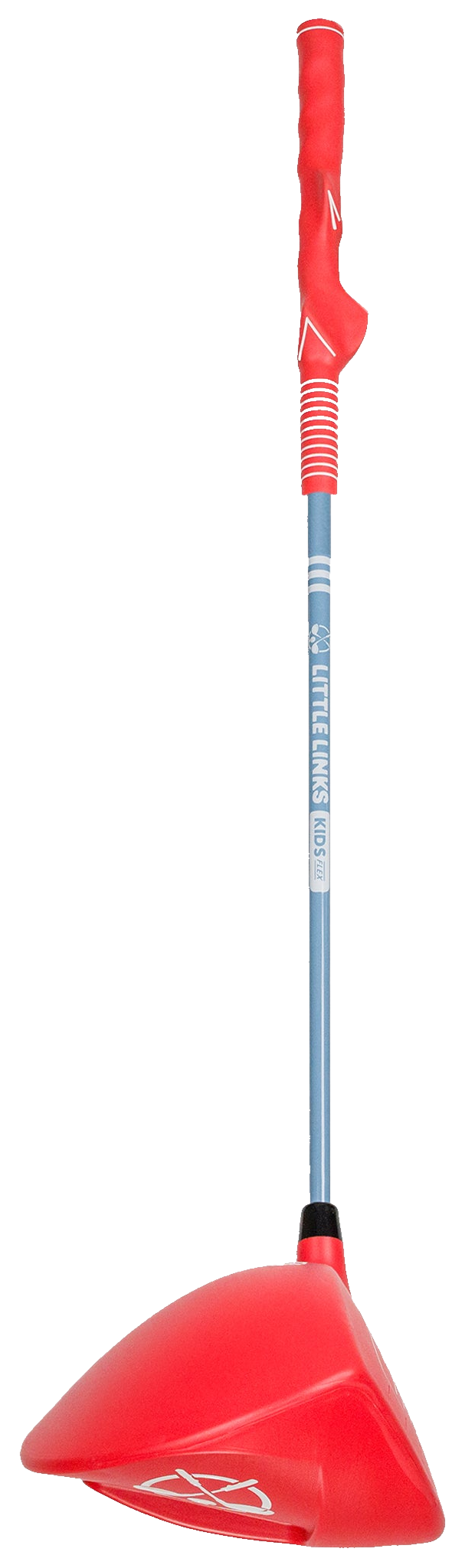
The Big Swing Driver is made for young golfers learning to swing a driver. Check height, swing side, and room to practice before choosing. If today's game is putting or chipping, start there. There will be plenty of time for other shots.
What to try next
Choose driver first when the child wants a supervised full-swing moment, the club is child-sized, the ball is teed up, and the space is safe. Choose an iron or wedge first when the goal is a smaller swing, a short target, a coach-led drill, or a child who is not ready for a longer club.
The best first club is the one that lets the child understand the task, stay safe, and want another turn. That’s the Little Links version of the driver-vs-iron answer: start with the moment, then pick the tool.
FAQ
Should kids start golf with a driver or an iron?
Kids should start with the club that matches the activity. Use a putter for rolling games, a short iron or wedge for small target swings, and a child-sized driver on a tee for supervised full swings when the space and fit are right.
Is a driver too hard for kids to learn with?
A full-size or overly long driver can be too hard for a child to manage. A child-sized driver can make sense for tee-up full swings when the child can control the club, the ball path is safe, and an adult is supervising.
When should kids use an iron first?
An iron or wedge can be the better first choice for small target swings, short chips, range lessons, and situations where the child is not ready for a longer full-swing club.
What club is best for a toddler's first golf swing?
For toddlers, the best first club is the one that fits the child and the activity. Many toddlers should start with rolling games, no-ball swings, soft balls, or a tee-up setup rather than an adult-style lesson.
Do kids need a full set before using a driver?
No. A child doesn’t need a full set before using a driver in a supervised tee-up setting. One useful club is enough when the club fits the child, the practice space is safe, and the session goal is simple.
Where does the Little Links Big Swing Driver fit?
The Big Swing Driver is made for young golfers learning to swing a driver. Check height, swing side, and room to practice before choosing. If today's game is putting or chipping, start there. There will be plenty of time for other shots.